
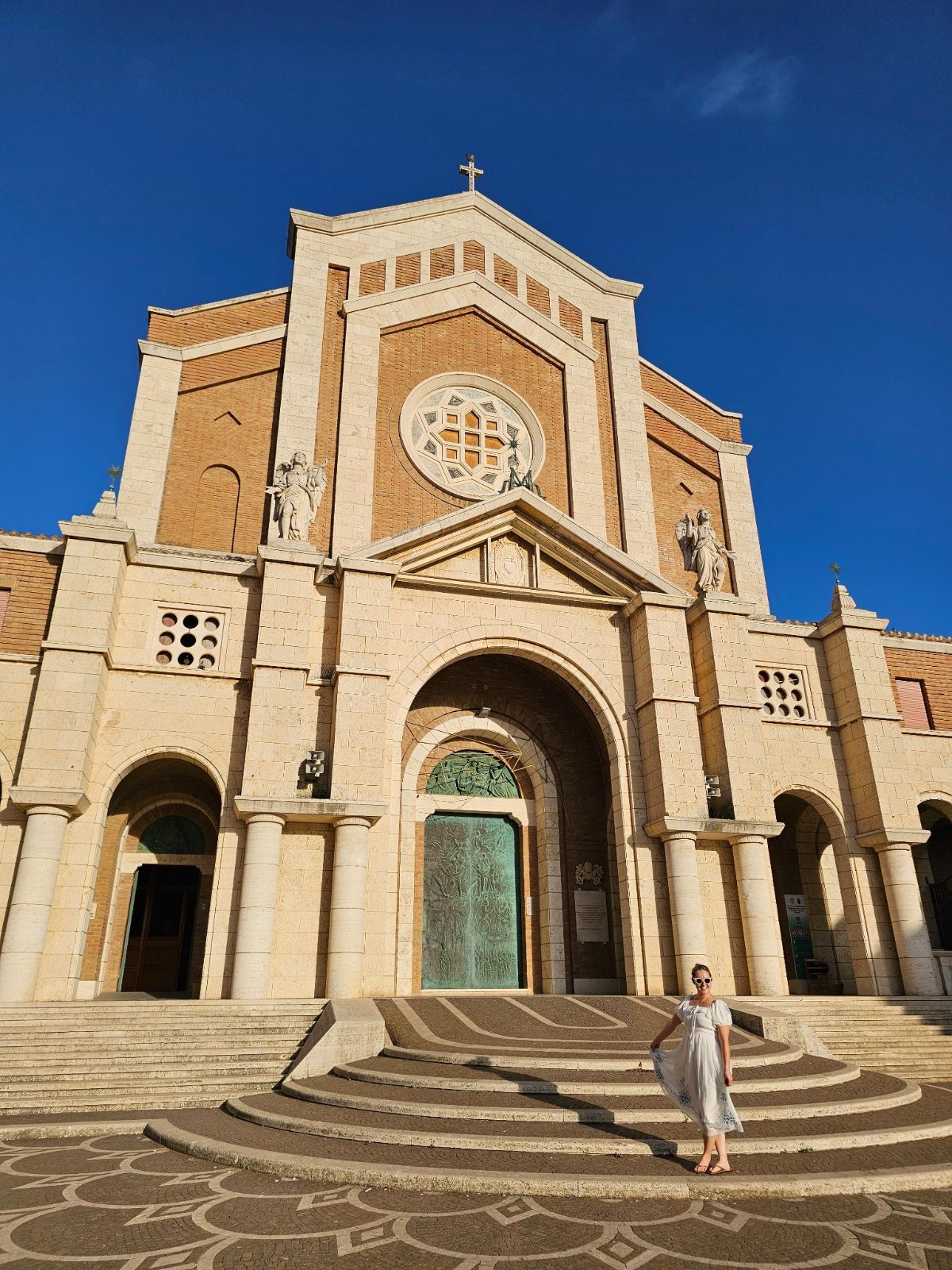
Basilica of Our Lady of Graces and St. Maria Goretti
This church houses the remains of St. Maria Goretti, and what is believed to be the statue of Our Lady of Grace. The remains of St. Maria Goretti lie in the crypt beneath the basilica. The bones are encased in a wax statue; she is not incorrupt. The church contains a statue called Our Lady of Grace, which may be the original statue from Ipswich. Our Lady of Ipswich, along with Our Lady of Walsingham, was one of the largest pilgrimage sites in England up until the Reformation. During this period, Our Lady of Grace may have been smuggled to Italy. In modern times, the faithful hold a procession with the statue on the first Saturday each May.
Basilica of St. Lawrence Outside the Walls
Site of the martyrdom of St. Lawrence, grilled to death. His relics are here, along with the relics of St. Stephen and St. Justin Martyr. Pope Pius IX is also buried here. This is one of the seven churches of Rome.
Basilica of St. Sebastian Outside the Walls
One of the seven pilgrim churches of Rome, the current church was built in 1714. The catacombs of St. Sebastian are nearby. St. Sebastian is below one of the side altars. One of the arrows that struck him and the column he was tied to are also here. Christ's footprints from when he met St. Peter on the Via Appia (Quo Vadis, Domine?) are here, as is a bust of Christ, which was Bernini's last sculpture.
Birthplace of St. Maria Goretti
Here St. Maria Goretti was born on October 16, 1890.
Catacombs of Priscilla
40,000 tombs line the 13km of tunnels in these catacombs. Some of those buried here include Pope Marcellinus, Pope Marcellus, Pope Sylvester, Felix and Philip, Pudenziana, and Praxedes, and Maurus and Simetrius. These catacombs also include the oldest depiction of the Virgin and Child, with the prophet Balaam.
Catacombs of St. Sebastian
Ancient publicly-accessible catacombs, named after St. Sebastian, who was buried here.
Church of St. Francis, Corinaldo
This was the Gorettis' parish church when they lived in Corinaldo. Here Luigi and Assunta Goretti were married and St. Maria Goretti baptized. The font where she was baptized is still preserved in the church.
Church of St. Ignatius of Loyola
17th-century Roman Catholic church with trompe l'oeil ceilings & frescoes depicting St. Ignatius. The Jesuits did not have enough money for a dome, so there is a fake dome painted on the ceiling. Sts. Aloysius Gonzaga, John Berchmans, and Robert Bellarmine are all buried here. From next to St. Aloysius' altar in the church, there is a stairway leading to his rooms, as well as the rooms of St. John Berchmans.
Diocesan Sanctuary of St. Maria Goretti
This church is the final resting place for St. Maria Goretti's mother, Assunta, and her repentant murderer, Alessandro Serenelli. There is also a relic of Maria's arm here.
Goretti House
Here St. Maria Goretti lived with her family and where she was martyred, stabbed by Alessandro Serenelli. She died the next day in a hospital in Nettuno. Today it is a museum.
Papal Archbasilica of St. John Lateran
As the cathedral of the Diocese of Rome, it is the official ecclesiastical seat of the Pope and ranks as the oldest and first among the four major papal basilicas. It holds the unique title of 'Mother and Head of all Churches in the City and the World.'
Papal Basilica of St. Mary Major
A wealthy but childless Christian Roman couple wanted to appoint the Virgin Mary as heiress of their property. On the night of August 4, Mary appeared simultaneously to the couple and Pope Liberius, expressing the wish that a church be erected on Esquiline Hill. The morning of August 5, miraculous snow fell on a narrow piece of land, upon which the Church of Liberius was constructed. This Marian shrine was replaced in the fifth century with a great church named Santa Maria Maggiore, which is now one of the four major basilicas. Today Mary's involvement in the original miracle has granted her the title "Our Lady of the Snows."
Papal Basilica of St. Paul Outside the Walls
Magnificent papal basilica dating from the 4th century, with tomb of St. Paul & elegant cloisters. Destroyed by fire in 1823, it was rebuilt and reconsecrated in 1854. Portraits of all the popes line the nave.
Sanctuary of Oropa
According to tradition, the statue known as the Black Madonna of Oropa was brought to Italy from the Holy Land by Bishop Eusebius of Vercelli in the fourth century A.D. Bl. Pier Giorgio Frassati would also hike in this area. His family villa was nearby, and he would visit the shrine regularly.
Sanctuary of Our Lady of Valverde
The Shrine of Our Lady of Valverde dates back to 1399, when Our Lady appeared to a farmer plowing his field. During the summer of 1711, when the province was hit by a severe epidemic, the inhabitants of Rezzato prayed to Our Lady of Valverde. On October 1, Our Lady appeared a second time to Paul Ogna, 8, and Francesco Pelizzari, 11, who went to collect chestnuts near the Sanctuary pond. Our Lady promised the end of the epidemic.
Sanctuary of the Virgin of the Revelation (Tre Fontane Grotto)
Our Lady of Revelation appeared in this grotto next to Tre Fontane in the 1947 to Bruno Cornacchiola, a communist, seventh-day adventist, and would-be assasin of Pope Pius XII.
Sant'Andrea delle Fratte (St. Andrew of the Thickets)
Marie Alphonse Ratisbonne, an anti-Catholic Jew, befriended a baron in Rome and began wearing the Miraculous Medal as a simple test. On January 20, 1842, after entering the church of Sant'Andrea delle Fratte, Ratisbonne experienced a vision of the Blessed Virgin Mary. He converted to Catholicism, joined the priesthood, and began a ministry for the conversion of Jews. Today these apparitions go by the titles of "Our Lady of the Miracle" and "Our Lady of Zion."
Santa Maria in Cosmedin
Home of the Bocca della Verita, which according to popular myth will bite off the hand of any liar who sticks his hand into its mouth. The relics of a martyr, St. Cyrilla, are here. There is also a dubious relic of St. Valentine. The church today belongs to the Melkites.
Santa Maria Maddalena, Campo Marzio
International headquarters of the Congregation of Clerks Regular, Ministers of the Sick also known as Camilliani or Camillians. St. Camillus de Lellis purchased the property for his new order. The church, dedicated to St. Mary Magdelene, houses St. Camillus' relics, as well as the miraculous crucifix that embraced him on his death bed. Built on the ancient Field of Mars
St. Maria Goretti Tent of Pardon
The "Tent of Pardon" is the site where, according to the National Catholic Register (see linked article), St. Maria Goretti lay dying in Nettuno. It was here that she forgave her murderer, and may also be the place of her death.
Statue of St. Maria Goretti
A statue of St. Maria Goretti in Nettuno, the town where she died.
Tre Fontane (Three Fountains) Abbey
Officially Church of St. Paul at the Martyrdom, this church is located within a Cistercian (strict observance) abbey. The name "Tre Fontane" refers to the three fountains the church is built over. Tradition says that this is the spot where St. Paul was beheaded. His head bounced three times. Each place it bounced, a fountain sprang up. Note that there are three churches at this monastery. The church of Tre Fontane is the one furthest back.
Italy
Basilica of Our Lady of Graces and St. Maria Goretti
This church houses the remains of St. Maria Goretti, and what is believed to be the statue of Our Lady of Grace. The remains of St. Maria Goretti lie in the crypt beneath the basilica. The bones are encased in a wax statue; she is not incorrupt. The church contains a statue called Our Lady of Grace, which may be the original statue from Ipswich. Our Lady of Ipswich, along with Our Lady of Walsingham, was one of the largest pilgrimage sites in England up until the Reformation. During this period, Our Lady of Grace may have been smuggled to Italy. In modern times, the faithful hold a procession with the statue on the first Saturday each May.
Basilica of St. Lawrence Outside the Walls
Site of the martyrdom of St. Lawrence, grilled to death. His relics are here, along with the relics of St. Stephen and St. Justin Martyr. Pope Pius IX is also buried here. This is one of the seven churches of Rome.
Basilica of St. Sebastian Outside the Walls
One of the seven pilgrim churches of Rome, the current church was built in 1714. The catacombs of St. Sebastian are nearby. St. Sebastian is below one of the side altars. One of the arrows that struck him and the column he was tied to are also here. Christ's footprints from when he met St. Peter on the Via Appia (Quo Vadis, Domine?) are here, as is a bust of Christ, which was Bernini's last sculpture.
Birthplace of St. Maria Goretti
Here St. Maria Goretti was born on October 16, 1890.
Catacombs of Priscilla
40,000 tombs line the 13km of tunnels in these catacombs. Some of those buried here include Pope Marcellinus, Pope Marcellus, Pope Sylvester, Felix and Philip, Pudenziana, and Praxedes, and Maurus and Simetrius. These catacombs also include the oldest depiction of the Virgin and Child, with the prophet Balaam.
Catacombs of St. Sebastian
Ancient publicly-accessible catacombs, named after St. Sebastian, who was buried here.
Church of St. Francis, Corinaldo
This was the Gorettis' parish church when they lived in Corinaldo. Here Luigi and Assunta Goretti were married and St. Maria Goretti baptized. The font where she was baptized is still preserved in the church.
Church of St. Ignatius of Loyola
17th-century Roman Catholic church with trompe l'oeil ceilings & frescoes depicting St. Ignatius. The Jesuits did not have enough money for a dome, so there is a fake dome painted on the ceiling. Sts. Aloysius Gonzaga, John Berchmans, and Robert Bellarmine are all buried here. From next to St. Aloysius' altar in the church, there is a stairway leading to his rooms, as well as the rooms of St. John Berchmans.
Diocesan Sanctuary of St. Maria Goretti
This church is the final resting place for St. Maria Goretti's mother, Assunta, and her repentant murderer, Alessandro Serenelli. There is also a relic of Maria's arm here.
Goretti House
Here St. Maria Goretti lived with her family and where she was martyred, stabbed by Alessandro Serenelli. She died the next day in a hospital in Nettuno. Today it is a museum.
Papal Archbasilica of St. John Lateran
As the cathedral of the Diocese of Rome, it is the official ecclesiastical seat of the Pope and ranks as the oldest and first among the four major papal basilicas. It holds the unique title of 'Mother and Head of all Churches in the City and the World.'
Papal Basilica of St. Mary Major
A wealthy but childless Christian Roman couple wanted to appoint the Virgin Mary as heiress of their property. On the night of August 4, Mary appeared simultaneously to the couple and Pope Liberius, expressing the wish that a church be erected on Esquiline Hill. The morning of August 5, miraculous snow fell on a narrow piece of land, upon which the Church of Liberius was constructed. This Marian shrine was replaced in the fifth century with a great church named Santa Maria Maggiore, which is now one of the four major basilicas. Today Mary's involvement in the original miracle has granted her the title "Our Lady of the Snows."
Papal Basilica of St. Paul Outside the Walls
Magnificent papal basilica dating from the 4th century, with tomb of St. Paul & elegant cloisters. Destroyed by fire in 1823, it was rebuilt and reconsecrated in 1854. Portraits of all the popes line the nave.
Sanctuary of Oropa
According to tradition, the statue known as the Black Madonna of Oropa was brought to Italy from the Holy Land by Bishop Eusebius of Vercelli in the fourth century A.D. Bl. Pier Giorgio Frassati would also hike in this area. His family villa was nearby, and he would visit the shrine regularly.
Sanctuary of Our Lady of Valverde
The Shrine of Our Lady of Valverde dates back to 1399, when Our Lady appeared to a farmer plowing his field. During the summer of 1711, when the province was hit by a severe epidemic, the inhabitants of Rezzato prayed to Our Lady of Valverde. On October 1, Our Lady appeared a second time to Paul Ogna, 8, and Francesco Pelizzari, 11, who went to collect chestnuts near the Sanctuary pond. Our Lady promised the end of the epidemic.
Sanctuary of the Virgin of the Revelation (Tre Fontane Grotto)
Our Lady of Revelation appeared in this grotto next to Tre Fontane in the 1947 to Bruno Cornacchiola, a communist, seventh-day adventist, and would-be assasin of Pope Pius XII.
Sant'Andrea delle Fratte (St. Andrew of the Thickets)
Marie Alphonse Ratisbonne, an anti-Catholic Jew, befriended a baron in Rome and began wearing the Miraculous Medal as a simple test. On January 20, 1842, after entering the church of Sant'Andrea delle Fratte, Ratisbonne experienced a vision of the Blessed Virgin Mary. He converted to Catholicism, joined the priesthood, and began a ministry for the conversion of Jews. Today these apparitions go by the titles of "Our Lady of the Miracle" and "Our Lady of Zion."
Santa Maria in Cosmedin
Home of the Bocca della Verita, which according to popular myth will bite off the hand of any liar who sticks his hand into its mouth. The relics of a martyr, St. Cyrilla, are here. There is also a dubious relic of St. Valentine. The church today belongs to the Melkites.
Santa Maria Maddalena, Campo Marzio
International headquarters of the Congregation of Clerks Regular, Ministers of the Sick also known as Camilliani or Camillians. St. Camillus de Lellis purchased the property for his new order. The church, dedicated to St. Mary Magdelene, houses St. Camillus' relics, as well as the miraculous crucifix that embraced him on his death bed. Built on the ancient Field of Mars
St. Maria Goretti Tent of Pardon
The "Tent of Pardon" is the site where, according to the National Catholic Register (see linked article), St. Maria Goretti lay dying in Nettuno. It was here that she forgave her murderer, and may also be the place of her death.
Statue of St. Maria Goretti
A statue of St. Maria Goretti in Nettuno, the town where she died.
Tre Fontane (Three Fountains) Abbey
Officially Church of St. Paul at the Martyrdom, this church is located within a Cistercian (strict observance) abbey. The name "Tre Fontane" refers to the three fountains the church is built over. Tradition says that this is the spot where St. Paul was beheaded. His head bounced three times. Each place it bounced, a fountain sprang up. Note that there are three churches at this monastery. The church of Tre Fontane is the one furthest back.